At Some Point, Silence Isn’t Neutral Anymore

by | Apr 2, 2026 | Highlights, Perspectives, Society

#findingyourvoice

I’ve always had a strong sense of what felt right and what didn’t. From a young age, questions of justice and fairness mattered to me. Not in an abstract way, but in everyday situations. At school, later at university, in different work environments, and also in private life—I found it difficult to stay silent when someone was being treated unfairly.

That didn’t always make me popular. I’ve been called “woke”, sometimes “annoying”. But more often than not, it simply meant that I chose to say something when others preferred not to. Over time, this became less of a reaction and more of a pattern. If someone crossed a line, I would usually step in. Not loudly, not aggressively, but clearly enough that it became uncomfortable to pretend nothing had happened. Occasionally, this came at a cost—especially when it involved people in positions of authority. But it also meant that I could live with my own conscience, and that mattered more.

At the same time, I also learned that speaking up isn’t always straightforward. There are moments where doing more could unintentionally make things worse for the person you’re trying to support.

I still remember one situation, years ago, where a colleague made a remark towards a female colleague that crossed a line. I reacted, because to me it felt unacceptable. But when I later spoke to her privately, she asked me not to escalate it further. She was worried it might put her in a more difficult position. I respected that—and I still think it was the right decision. But it stayed with me. Because it showed that even when you want to do the right thing, it’s not always simple.

Looking back, this tension has been present throughout many of these moments: speaking up when you can, and stepping back when you should.

At the same time, I’ve been observing something else over the years. When I was younger, we spent a lot of time in school learning about history—about the consequences of racism, antisemitism, exclusion, and hate. There was a shared understanding that these were not ideas to be debated lightly. They were lessons learned the hard way. Over the past decades, however, I’ve had the feeling that some of these lines have become less clear. Not necessarily because people changed overnight, but because certain narratives have become more visible again, more present in everyday discussions.

And while this was happening, many people who would normally take a more thoughtful or nuanced position chose not to engage. They took what we often call the “high road”—avoiding confrontation, avoiding escalation, avoiding getting drawn into debates that seemed unproductive.

I understand that instinct. I’ve shared it. But I’ve also started to wonder whether choosing the high road sometimes means leaving the field open.

This became even more apparent during the COVID years. Conversations became more polarized, more emotional, and often louder. Some voices tried to explain, to discuss, to add nuance. Others relied on simpler, more direct messages—often built on fear or distrust. And in many cases, it was those louder messages that reached more people.

Recently, I’ve also noticed how speaking up has taken on new forms. A younger generation is using humor, irony, and creativity to address serious topics. Sometimes through visuals, sometimes through merchandise, sometimes by reclaiming language that was previously used against them.

At the same time, these forms of expression can come with very real consequences—public exposure, backlash, even threats. Speaking up today is visible in a way it wasn’t before. And that visibility comes with risks.

Alongside this, I’ve also found myself looking more closely at online cultures and narratives that shape how young people think and interact. Some of these are subtle, some are not. But taken together, they raise questions about how ideas around respect, gender, power, and identity are evolving—and how easily certain patterns can reappear if they are not addressed.

All of this has been happening in parallel with something more personal.

For a long time, I’ve been operating at a high level of intensity—pushing through, continuing, functioning. It’s a mindset that many of us are familiar with, especially if we’ve been taught that being strong means enduring without questioning. At some point, however, that approach starts to show its limits. And when it does, it forces you to reflect—not only on your own well-being, but also on what you choose to invest your energy in.

Looking back at the past years, I realized something: I have continued to speak up in individual situations, in conversations, in moments where I felt it mattered. But I had stopped doing it more publicly. Not because the topics became less important. If anything, the opposite is true. But perhaps because it felt easier to keep it local, controlled, and limited. Recently, however, that has started to change again.

Seeing how others express their views—sometimes creatively, sometimes boldly, sometimes at personal risk—made me reflect on my own position. Not in a comparative way, but as a reminder that having a voice also comes with a responsibility to use it.

And sometimes, that doesn’t only mean speaking up. Sometimes it also means showing support in small, tangible ways—buying a coffee cup from Olivier Caffè and drinking a “Bella Ciao”, wearing a Migrantengöre beanie, an “Ich gender, und jetzt?” hoodie, or simply a rainbow wristband.

Carrying a message forward in everyday life. Not loudly, not aggressively—but visibly. And yes, in a way, that is promotion. But it is also a conscious choice about what—and who—you support. This doesn’t mean becoming the loudest person in the room. It doesn’t mean reacting to everything. And it certainly doesn’t mean having all the answers. But it does mean not defaulting to silence. So this is, in a way, a return.

Not to something entirely new, but to something that has been there for a long time—just expressed differently now, with more experience, and hopefully with more perspective. I don’t expect everyone to agree with what I write. That’s not the point.

The point is simply this: At some point, silence isn’t neutral anymore.

Whether you choose to speak up, or simply support those who do—maybe it all starts with finding your own voice.
If you’re curious, here are a few of the creators and initiatives I mentioned, whose work resonates with me:

Suggested by Bisi

0 Comments

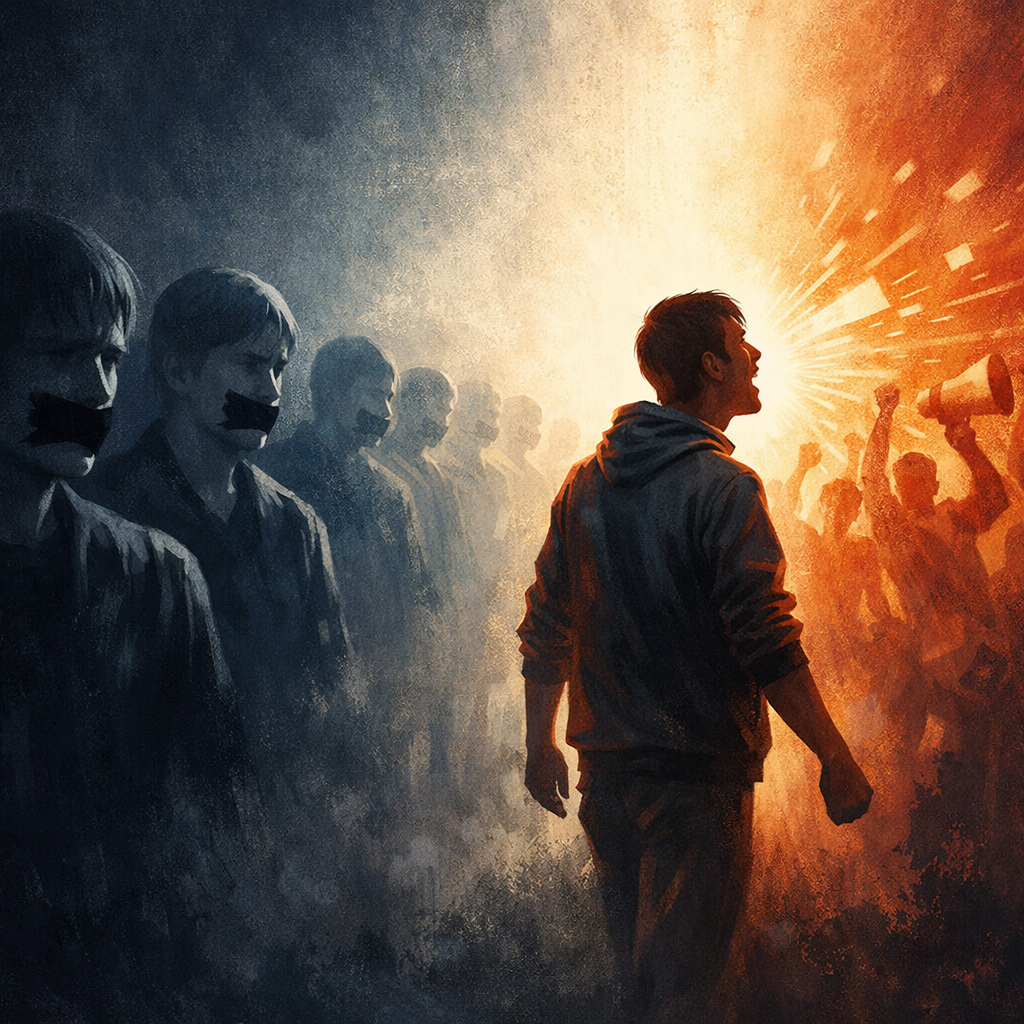
Photo by Mirko Fabian: https://www.pexels.com/photo/oscar-academy-trophy-award-12282183/

The Oscars 2026: Hope, Humor, and a World That Still Needs Fixing

A night of powerful messages, missed opportunities — and the frustrating reality of watching it from Europe There are evenings when you watch an awards show simply to see who wins. And then there are evenings when the show becomes something more — a mirror reflecting...

Growing up online: what I wish more parents talked about

A personal reflection from a father and youth professional on the hidden dangers young people may face online — and why silence, more than technology, can put children at risk.

The Spleen of the 21st Century

Why We Must Do Better—For Ourselves, and Those Who Come After Us There is a growing sense of unease I’ve come to feel more and more acutely—not just personally, but in the way society moves, speaks, and acts. It’s hard to name at first, but it’s everywhere: the...
(Focus Features, Universal Pictures, 2023)

Why Champions and The Peanut Butter Falcon Should Be on Everyone’s Watchlist

There are movies that entertain us, movies that challenge us, and movies that change us. Champions and The Peanut Butter Falcon fall into that last category. These films offer a glimpse into a world that many of us rarely engage with directly, and yet, when we do, it...

L’Agence: A Window into Luxury Living or Just an Easy Watch?

Introduction In the realm of reality TV, L’Agence offers a unique glimpse into the luxurious world of high-end real estate through the lens of the Kretz family. This French series combines stunning landscapes and opulent properties with the day-to-day interactions of...
Still image from Murder Mindfully on Netflix (https://about.netflix.com/en/news/murder-mindfully-launch-date-announced-and-first-look-pictures-available)

Murder Mindfully: More Than Just a Thriller—It’s a Must-Watch Crime Show

There’s something special about starting a show with zero expectations and ending up completely hooked. That’s exactly how I discovered Murder Mindfully. I had never heard of it before, didn’t know it was based on a book series by a German author, and had no idea what...

Is ‘Doppelhaushälfte’ the real Germany?

In the vast landscape of German television, 'Doppelhaushälfte' stands out as a series that not only entertains but also provokes thought. Produced by the ZDF under their label NEORiginal, it dives deep into societal norms, challenging viewers to reflect on the...
Image of Harrison Ford and Jason Segel from Shrinking, the show on Apple TV+. Image downloaded from https://www.apple.com/tv-pr/originals/shrinking/episodes-images/

Shrinking: An Unexpected Gem

"Shrinking" was a surprising delight for me. I had initially dismissed it as just another star-studded project, but after seeing the genuine connection between the cast at the SAG Awards this week, I decided to give it a shot. From the very first episode, it...
The watcher

Welcome to “The Bingers”

If you love diving into new series, exploring different genres, and discovering hidden gems across streaming platforms, you’ve come to the right place! This blog isn’t just about reviewing shows—it’s about breaking them down, analyzing what makes them great (or...

Serra da Estrela

My children’s grandfather hails from a quaint village nestled near Seia, cradled within the majestic embrace of the Serra da Estrela mountains. May the images I share below capture the breathtaking beauty of this enchanting land, revealing its splendor to your heart....

Pin It on Pinterest

Share This