
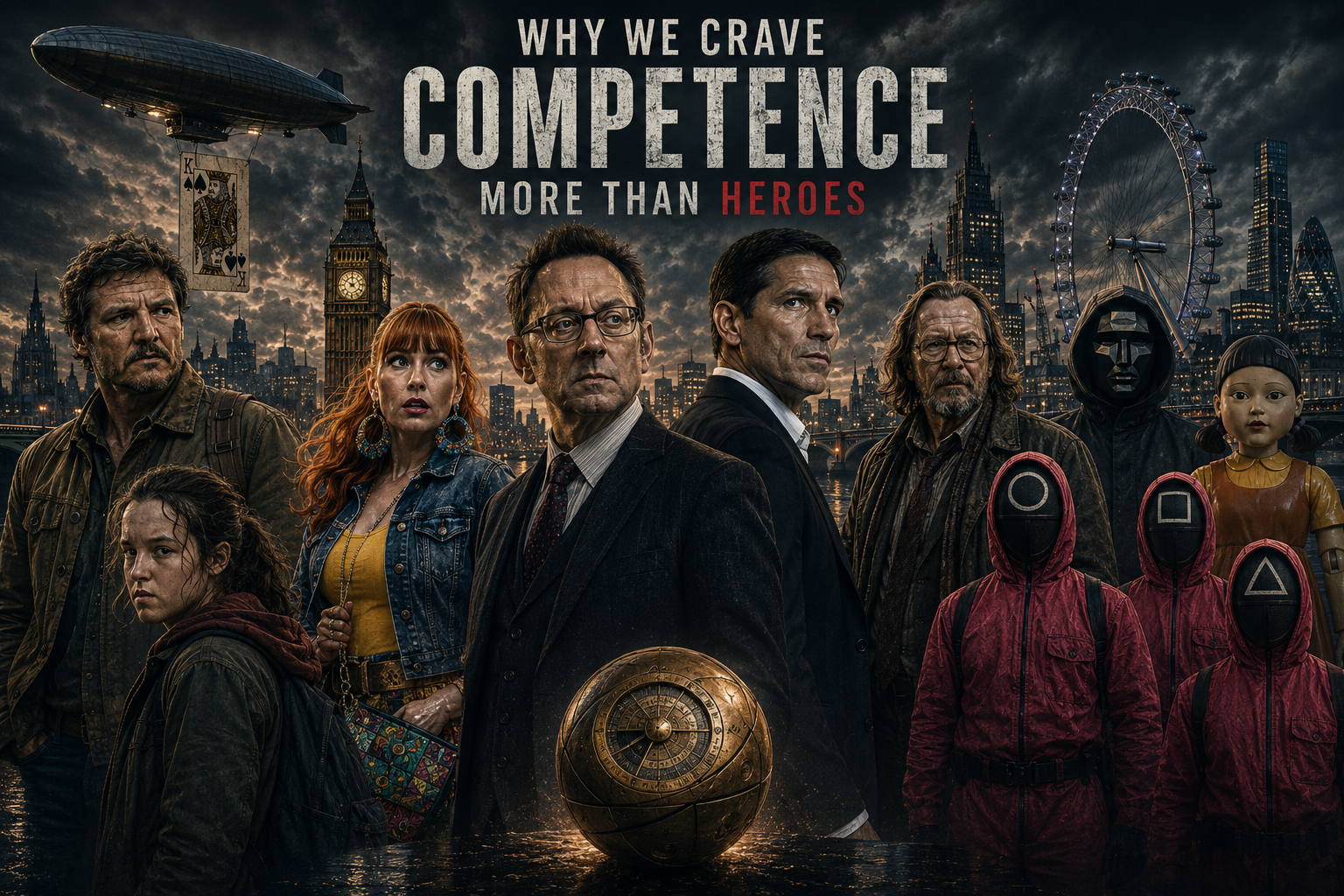
There was a time when television heroes were simple. They were strong, morally clear, almost invincible. They entered a room, solved the problem, saved the world and left with barely a scratch. Audiences admired them, but rarely truly recognized themselves in them.
Modern television changed that.
Today, many of the most fascinating characters on screen are no longer heroes in the traditional sense. They are exhausted analysts, socially awkward geniuses, disgraced agents, traumatized survivors, manipulative strategists or deeply flawed individuals trying to do the right thing in systems that often seem broken beyond repair.
And maybe that says a lot about us.
Competence became comforting
One of the clearest examples remains Person of Interest (on netflix.com). Looking back, it almost feels absurd how visionary the show was. Long before the current explosion of artificial intelligence discussions, it was already asking questions many people only started realizing years later:
- Who controls AI?
- Does morality matter when the system becomes powerful enough?
- Is the real power the algorithm itself, or the data it feeds on?
- Can machines become more ethical than humans?
- How quickly does technological evolution escape its creators?
The show understood something early: technology itself is rarely the real danger. The danger lies in who controls it, who trains it, who profits from it, and who gets sacrificed along the way.
What made the series exceptional, however, was not only its technological foresight. It was the humanity underneath. Characters constantly operate in morally grey territory. Assassins become protectors. Manipulators seek redemption. Broken people sacrifice themselves for others. Viewers end up deeply attached to characters who, in another story, would simply have been villains.
And that is perhaps one of the defining characteristics of modern prestige television:
We no longer crave perfect heroes. We crave competent people trying to do better.
The antihero became more human
Slow Horses (on tv.apple.com) understands this perfectly. At first glance, the agents of Slough House are failures. Burnt-out rejects. Embarrassments to the intelligence world. And yet, the deeper the story goes, the more the audience realizes that these damaged individuals may actually be the only people still capable of functioning honestly inside a cynical and politically compromised system.
The brilliance of the series lies in how intelligent and intricate it becomes without ever losing its humanity. You root for these antiheroes almost against your own will. Not because they are glamorous. Not because they are morally pure. But because they feel painfully real.
Their exhaustion feels real. Their frustration feels real. Their small victories feel earned.
Modern audiences increasingly seem to trust flawed competence more than polished perfection.
We no longer trust systems — only individuals
This theme also appears in The Night Agent (on netflix.com) and The Recruit (also on netflix.com). Both series give us underdogs navigating institutions that are often manipulative, opaque or simply overwhelmed by their own complexity. The audience enjoys watching characters forced to improvise inside systems that clearly no longer function properly.
Modern life often feels bureaucratic, fragmented, exhausting, technologically overwhelming, and emotionally disconnected. That may explain why viewers connect so strongly to these stories today.
So when a capable outsider manages to survive that chaos through intelligence, adaptability or resilience, it becomes deeply satisfying to watch.
Interestingly, the later evolution of The Night Agent perhaps also shows the limits of this balance. As the protagonist increasingly transforms into a near-superhuman operator, some of the emotional relatability disappears. The more invincible he becomes, the less human he feels.
Competence fascinates us.
Perfection distances us.
Intelligence became fantasy fulfillment
Then there is High Potential (on disneyplus.com). It is sometimes absurd. Sometimes cringe. Sometimes almost cartoonishly exaggerated.
And yet it works.
Because beneath the eccentricity lies a very modern fantasy: the idea that intelligence, intuition and unconventional thinking might still matter in a world dominated by rigid structures and routines.
Shows like this allow viewers to imagine:
“Maybe I could see patterns others miss too.”
It scratches the same itch as Sherlock, House or even parts of Person of Interest. Not necessarily power fantasies. But competence fantasies. The dream that intelligence could still give meaning, direction or identity inside a confusing world.
Complexity replaced morality
What unites many modern series is not simply “good writing”. It is moral complexity. Very few of the most discussed modern shows still operate in clear black-and-white morality. Whether in:
- The Last of Us (hbomax.com)
- Alice in Borderland (netflix.com)
- Dark (netflix.com)
- Invasion (tv.apple.com)
- Paradise (disneyplus.com)
- House of the Dragon (hbomax.com)
- Dune (hbomax.com)
- Vincenzo (netflix.com)
- The White Lotus (hbomax.com)
- Avenue 5 (hbomax.com)
- His Dark Materials (hbomax.com)
- or The Wheel of Time (primevideo.com)
…the real question is rarely:
“Who is good?”
Instead, the question becomes:
“What would you do in their position?”
That shift may explain why modern television feels more psychologically engaging than ever.
The audience is no longer simply observing morality.
The audience is constantly negotiating it internally.
Maybe this says more about us than about television
Perhaps modern viewers no longer believe in heroes because the world itself has become too complicated for simplistic morality. But competence? Competence still matters.
People still long for capable leaders, intelligent problem-solvers, emotionally resilient individuals, and humans who can navigate chaos without losing themselves completely. Maybe that is why these stories resonate so deeply.
Not because they show us perfect people. But because they show us flawed individuals trying to remain functional, moral and human inside systems that increasingly seem designed to break all three.






0 Comments